Why America Still Won't Go Metric: The Story
The surprising history of why the US still uses imperial measurements when nearly every other country has gone metric. Spoiler: they actually tried.
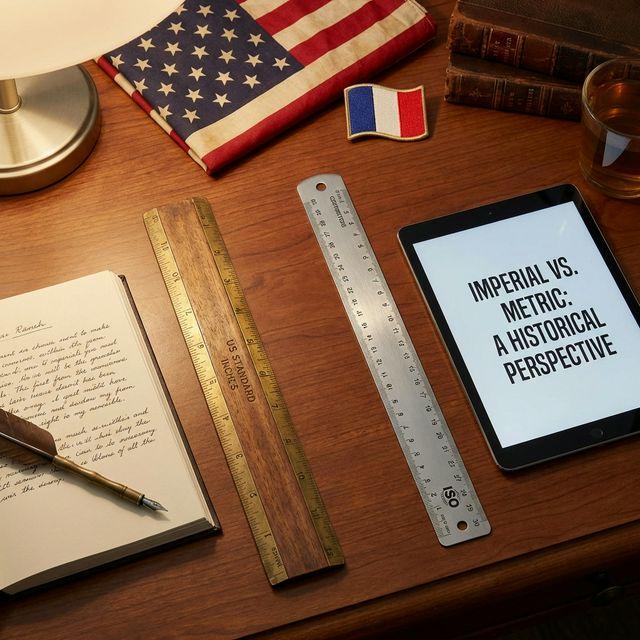
Only Three Countries Don't Use Metric
The United States, Myanmar, and Liberia. That's it. Every other country on Earth has officially adopted the metric system. So what happened?
The answer involves pirates, Congress, and a surprisingly expensive road sign.
A Brief History of Measurement Chaos
Before Standardization
In medieval Europe, measurements were a disaster:
- A "foot" was literally based on the king's foot (it changed with each king)
- A "yard" was the distance from the king's nose to his outstretched thumb
- An "acre" was the amount of land a team of oxen could plow in one day
- A "mile" came from the Roman "mille passus" (1,000 paces)
- Meter: 1/10,000,000 of the distance from the equator to the North Pole
- Gram: Weight of 1 cubic centimeter of water
- Liter: 1,000 cubic centimeters
- Every road sign in America (replacing or adding metric)
- Manufacturing equipment retooled for metric
- Building codes rewritten
- Plumbing and construction materials restandardized
- The US has approximately 30 million road signs
- Replacing or supplementing each one costs hundreds of dollars
- Total: billions just for road signs
- "I know what 72 degrees feels like. What's 22 Celsius?"
- Recipes passed down for generations use cups and teaspoons
- Football fields are 100 yards, not 91.44 meters
- "I'm 5 foot 10" is deeply ingrained in identity
- Lumber is standardized to imperial (2x4, 4x8 sheets)
- Every blueprint, code, and regulation would need rewriting
- Workers retrained
- Retooling factories is enormously expensive
- Existing inventory becomes incompatible
- Supply chains disrupted during transition
Every town had slightly different measurements. Trade was a nightmare.
The French Solution (1799)
France created the metric system based on nature:
Everything scales by powers of 10. Simple. Elegant. Logical.
America Almost Went Metric (Twice)
Attempt 1: The 1790s
Thomas Jefferson proposed a decimal measurement system for the new nation. Congress was interested but delayed. Meanwhile, France sent scientist Joseph Dombey to America with official metric standards (a copper kilogram and a meter rod).
His ship was blown off course to the Caribbean, where he was captured by pirates. He died in captivity. The metric standards never arrived.
Some historians call this the reason America isn't metric today.
Attempt 2: The 1970s
In 1975, Congress passed the Metric Conversion Act, establishing a voluntary transition to metric. President Gerald Ford signed it. The US Metric Board was created.
The key word: voluntary.
Without mandatory requirements, industries that would bear the conversion cost lobbied against it. Public interest faded. President Reagan disbanded the US Metric Board in 1982.
Why It's So Hard to Switch
The Cost Problem
Converting isn't just about learning new numbers. It requires:
Infrastructure changes:
Estimated cost: Various studies have put a full US conversion at hundreds of billions of dollars.
Road signs alone:
The Human Factor
People resist change, especially in daily life:
The Industry Pushback
Key industries opposed conversion:
Construction:
Manufacturing:
America Is More Metric Than You Think
Despite the perception, the US actually uses metric extensively:
Science and Medicine: All scientific research uses metric. Medications are dosed in milligrams and milliliters, and lab work is done entirely in metric units.
Military: NATO standardization requires metric. Maps use kilometers, and ammunition is measured in millimeters (5.56mm, 9mm).
Trade and Manufacturing: Car engines are measured in liters (2.0L, 3.5L). Nutrition labels show grams. Photography uses millimeters (50mm lens). Electronics use metric (3.5mm jack).
Food and Drink: Wine and spirits come in milliliters and liters (750mL bottle). Soda is sold in liters (2-liter bottle). Nutrition facts are listed in grams.
Sports: Track and field uses 100 meters, 5K, 10K, and marathon (42.195 km). Swimming pools are 50m. All Olympic events are metric.
The Dual System Problem
Living with both systems causes real issues:
The Mars Climate Orbiter ($327 Million Mistake)
In 1999, NASA lost the Mars Climate Orbiter because one engineering team used imperial units and another used metric. The spacecraft received thrust calculations in pound-force instead of newtons.
It entered the Mars atmosphere at the wrong angle and was destroyed. Cost: $327.6 million.
Medical Errors
Unit confusion between metric and imperial has contributed to medication dosing errors. A dose meant in milligrams interpreted as another unit can be dangerous.
Trade Complications
US manufacturers often maintain two product lines - imperial for domestic and metric for export. This adds cost and complexity.
Countries That Successfully Switched
United Kingdom
Officially metric since 1965, but still uses miles for road distances. People use stone for body weight and pints for beer. It shows that switching is gradual and messy.
Canada
Switched in the 1970s. Weather is in Celsius and distances in kilometers, but people still use feet and inches for height. Close to full adoption after 50 years.
Australia
Switched in 1970, completed by the mid-1980s. Full adoption in daily life. Considered one of the most successful transitions worldwide.
Common factor: Government-mandated transitions with set deadlines work. Voluntary ones don't.
The Gen Z Metric Shift
Younger Americans are increasingly metric-comfortable. School science is taught exclusively in metric. International online communities use metric. Global content on YouTube and social media is metric. Gaming and tech industries use metric. And travel to metric countries exposes them to it firsthand.
Some predict a gradual, organic shift rather than a mandated one.
Quick Conversion Reference
| Measurement | Imperial | Metric |
| Length | 1 inch | 2.54 cm |
| Length | 1 foot | 30.48 cm |
| Length | 1 yard | 0.914 m |
| Length | 1 mile | 1.609 km |
| Weight | 1 ounce | 28.35 g |
| Weight | 1 pound | 453.6 g |
| Weight | 1 stone | 6.35 kg |
| Weight | 1 ton | 907 kg |
| Temperature | 32°F | 0°C |
| Temperature | 68°F | 20°C |
| Temperature | 98.6°F | 37°C |
| Temperature | 212°F | 100°C |
| Volume | 1 fl oz | 29.57 mL |
| Volume | 1 cup | 236.6 mL |
| Volume | 1 pint | 473.2 mL |
| Volume | 1 gallon | 3.785 L |
Convert Any Measurement Instantly
Tired of doing the mental math? Use our unit converter to convert between metric and imperial instantly. Supports length, weight, volume, temperature, and dozens of other unit types.
Disclaimer
This article is for informational and educational purposes only. Historical facts and conversion figures are presented to the best of our knowledge and may be subject to interpretation. Convertz.app provides conversion tools only.

Andrew
·Founder of ConvertzBuilding free, accurate conversion tools for everyone. All content is AI-assisted and editorially reviewed for accuracy. Learn more about Convertz
Try Our Free Converters
Convert currencies, cryptocurrencies, units, and files instantly with our free online tools.
Related Articles

The End of Financial Privacy? Programmable Money and Who Controls Your Cash
Digital money can be tracked, controlled, and frozen in ways physical cash never could. As CBDCs, stablecoins, and programmable payments replace cash, who gets to watch — and who gets to decide what you can spend? The privacy battle behind the future of money.

When Software Becomes the Customer: Inside the AI-Agent Economy
For all of history, every transaction had a human on at least one end. In 2026 that ended — AI agents now shop, negotiate, and pay on their own. Here is how the machine economy works, who is racing to build its payment rails, and what it means for you.

Gold Just Beat US Treasuries — The Hard-Asset Side of the New Money System
For the first time since 1996, the gold held by foreign central banks is worth more than their US Treasury holdings. As money goes digital, the world is quietly re-anchoring to hard assets — gold, silver, copper, uranium. Here is the resource story behind the financial revolution.
Related across Convertz
Country guides, key terms, and rate history that connect to this article.
Country guides
Glossary
- Mid-Market RateThe mid-market rate is the midpoint between the buy (bid) and sell (ask) price of a curren…
- Pip (Forex)A pip ("percentage in point") is the smallest standard price increment for a currency pair…
- Spread (Forex)The spread is the difference between the buy (ask) price and the sell (bid) price of a cur…
Rate history
- ETH/USD historyEthereum's history since its 2015 launch has been one of the most consequential in crypto
- USD/KRW historyUSD/KRW is one of Asia's most-traded emerging-market currency pairs — heavily linked to Korean technology exports (Samsung, SK Hynix, Hyundai), semiconductor cycles, and global risk sentiment