What Is Forex Trading? A Beginner's Guide
Learn the basics of forex trading, how the foreign exchange market works, key terminology, and what beginners need to know before getting started.
What Is the Forex Market?
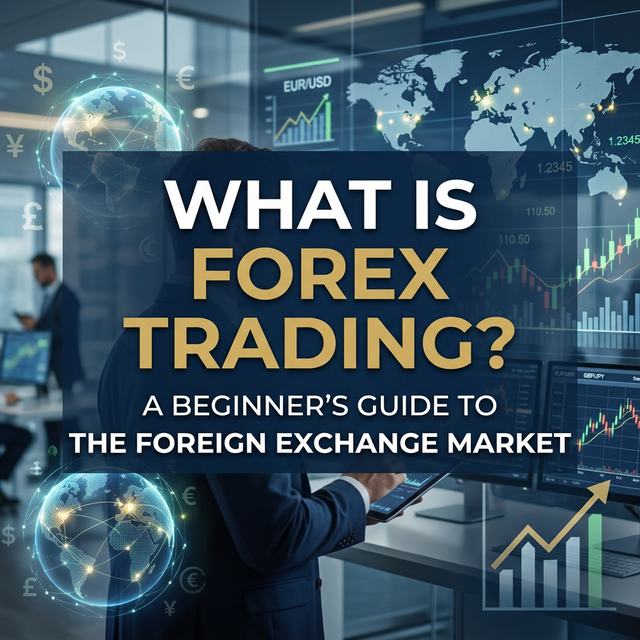
The foreign exchange market, commonly called forex or FX, is where currencies are traded against each other. It is the largest and most liquid financial market in the world, with a daily trading volume exceeding $7.5 trillion in 2026.
Unlike stock markets, forex has no central exchange. It operates as an over-the-counter (OTC) market, meaning trades happen electronically between participants around the world — banks, institutions, corporations, governments, and individual retail traders.
How Forex Trading Works
At its core, forex trading is simple: you buy one currency while simultaneously selling another. Currencies are always traded in pairs, such as EUR/USD (Euro vs. US Dollar) or GBP/JPY (British Pound vs. Japanese Yen).
The Basics of a Currency Pair
Every currency pair has two components:
- Base currency: The first currency listed (e.g., EUR in EUR/USD)
- Quote currency: The second currency listed (e.g., USD in EUR/USD)
- EUR/USD, GBP/USD, USD/JPY, USD/CHF, AUD/USD, USD/CAD, NZD/USD
- EUR/GBP, EUR/JPY, GBP/JPY, AUD/NZD
- USD/TRY, EUR/ZAR, GBP/MXN
- Standard lot: 100,000 units of the base currency
- Mini lot: 10,000 units
- Micro lot: 1,000 units
- Nano lot: 100 units
- Interest rate decisions (the single most important driver)
- GDP growth
- Inflation reports (CPI, PPI)
- Employment data (Non-Farm Payrolls in the US)
- Trade balance
- Political events and elections
- Support and resistance levels
- Moving averages
- Relative Strength Index (RSI)
- MACD (Moving Average Convergence Divergence)
- Candlestick patterns
- Educate yourself thoroughly before risking real money. Read books, take courses, and follow reputable forex education resources.
- Start with a demo account. Every major broker offers free demo accounts where you can practise with virtual money. Trade on demo for at least 2-3 months before going live.
- Choose a regulated broker. Look for regulation by the FCA (UK), SEC/CFTC (US), ASIC (Australia), or CySEC (EU). Avoid unregulated brokers.
- Start small. Begin with a micro account and risk no more than 1-2% of your capital on any single trade.
- Keep a trading journal. Record every trade, your reasoning, and the outcome. This is the single best habit for improving as a trader.
- Use tools to stay informed. Track live exchange rates on platforms like Convertz.app, follow economic calendars for major data releases, and stay current on market news.
- Over-leveraging: Using maximum leverage too early is the fastest way to blow an account
- Not using stop losses: Every trade should have a predefined exit point for losses
- Overtrading: Taking too many positions or trading when there is no clear setup
- Ignoring risk management: Professional traders focus on managing risk first, profits second
- Chasing losses: Increasing position sizes to recover losses almost always makes things worse
If EUR/USD is quoted at 1.0850, it means 1 Euro costs 1.0850 US Dollars. If you believe the Euro will strengthen against the Dollar, you buy the pair (go long). If you believe it will weaken, you sell the pair (go short).
Types of Currency Pairs
Major pairs — The seven most traded pairs, all involving the USD:
Minor pairs (crosses) — Pairs of major currencies that do not include USD:
Exotic pairs — A major currency paired with a currency from a developing economy:
You can check live rates for any of these pairs using our currency converter on Convertz.app.
Key Forex Terminology
Pip
A pip (percentage in point) is the smallest standard price movement in a currency pair. For most pairs, one pip equals 0.0001 (the fourth decimal place). For JPY pairs, one pip equals 0.01.
If EUR/USD moves from 1.0850 to 1.0865, it has moved 15 pips.
Spread
The spread is the difference between the bid price (what you can sell at) and the ask price (what you can buy at). This is essentially the transaction cost. Major pairs have tight spreads (1-2 pips), while exotic pairs can have spreads of 20+ pips.
Leverage
Leverage allows you to control a large position with a small amount of capital. If your broker offers 50:1 leverage, a $1,000 deposit lets you control a $50,000 position.
Leverage is a double-edged sword. It magnifies profits when you are right but equally magnifies losses when you are wrong. A 2% move against a 50:1 leveraged position wipes out 100% of your capital.
Lot Size
Forex is traded in standardised amounts called lots:
Most retail brokers allow trading in micro or mini lots, making it accessible to traders with smaller accounts.
Who Trades Forex and Why?
Banks and Financial Institutions
The largest participants, accounting for the majority of daily volume. They trade for profit and to facilitate client transactions.
Corporations
Multinational companies trade forex to hedge against currency risk. A US company paying European suppliers in Euros needs to buy EUR/USD to make those payments.
Central Banks
Central banks intervene in forex markets to manage their currency's value and implement monetary policy. These interventions can cause significant market moves.
Retail Traders
Individual traders like you, accessing the market through online brokers. Retail trading accounts for roughly 5-6% of total forex volume, but this segment has grown significantly with the rise of online trading platforms.
The Three Types of Forex Analysis
1. Fundamental Analysis
Studying economic indicators, central bank policies, and geopolitical events to predict currency movements. Key indicators include:
2. Technical Analysis
Using charts, patterns, and indicators to predict future price movements based on historical data. Common tools include:
3. Sentiment Analysis
Gauging the overall mood of the market. Tools like the Commitment of Traders (COT) report and retail positioning data show whether traders are predominantly long or short on a currency pair.
Getting Started: Practical Steps
Common Mistakes Beginners Make
The Reality Check
Forex trading is not a get-rich-quick scheme. The statistics are sobering: most regulatory data shows that 70-80% of retail forex accounts lose money. The traders who succeed treat it as a serious discipline requiring education, practice, emotional control, and consistent risk management.
If you are interested in currencies but not ready for active trading, simply following exchange rate movements and understanding what drives them is valuable knowledge for travel, international business, and personal finance.
Disclaimer
This article is for educational purposes only and does not constitute financial or investment advice. Forex trading involves substantial risk of loss and is not suitable for all investors. Past performance is not indicative of future results. Never trade with money you cannot afford to lose.
Live Currency Converter
Convert between 150+ currencies at the live mid-market rate — refreshed every minute from Frankfurter (ECB reference data).
Andrew
·Founder of ConvertzBuilding free, accurate conversion tools for everyone. All content is AI-assisted and editorially reviewed for accuracy. Learn more about Convertz
Try Our Free Converters
Convert currencies, cryptocurrencies, units, and files instantly with our free online tools.
Related Articles

The End of Financial Privacy? Programmable Money and Who Controls Your Cash
Digital money can be tracked, controlled, and frozen in ways physical cash never could. As CBDCs, stablecoins, and programmable payments replace cash, who gets to watch — and who gets to decide what you can spend? The privacy battle behind the future of money.

When Software Becomes the Customer: Inside the AI-Agent Economy
For all of history, every transaction had a human on at least one end. In 2026 that ended — AI agents now shop, negotiate, and pay on their own. Here is how the machine economy works, who is racing to build its payment rails, and what it means for you.

Gold Just Beat US Treasuries — The Hard-Asset Side of the New Money System
For the first time since 1996, the gold held by foreign central banks is worth more than their US Treasury holdings. As money goes digital, the world is quietly re-anchoring to hard assets — gold, silver, copper, uranium. Here is the resource story behind the financial revolution.
Related across Convertz
Country guides, key terms, and rate history that connect to this article.
Glossary
- LiquidityLiquidity is the ease with which an asset can be bought or sold without significantly affe…
- Pip (Forex)A pip ("percentage in point") is the smallest standard price increment for a currency pair…
- Spread (Forex)The spread is the difference between the buy (ask) price and the sell (bid) price of a cur…