Epstein Files: How They're Shaking Markets
How the Epstein files are affecting stocks, crypto, gold, and banking — from Microsoft's sell-off to Bitcoin's crash and gold at $4,700.
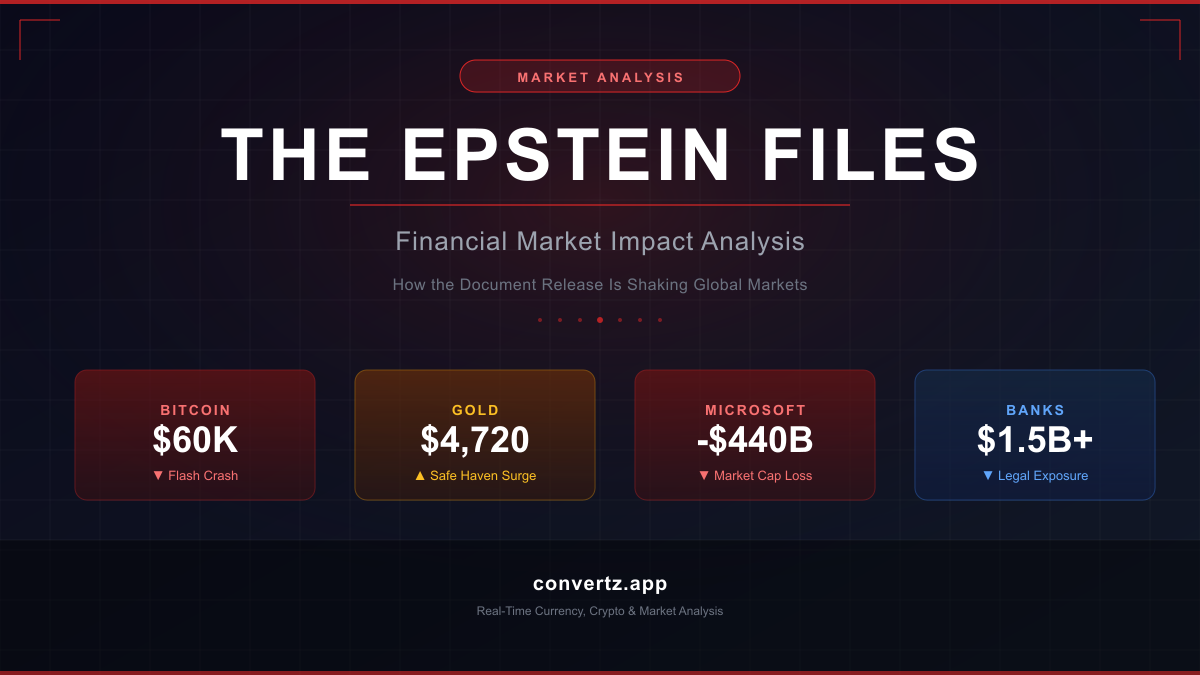
The Epstein Files and Financial Markets: What the Data Shows
The release of the Epstein files — mandated by the Epstein Files Transparency Act signed into law on November 19, 2025 — has sent ripple effects through virtually every corner of the financial system. From Wall Street banks paying billions in settlements to Bitcoin crashing below $60,000, the documents have exposed connections between one of the most notorious figures of the century and the institutions that manage the world's money.
This isn't speculation. These are documented financial movements, settlement figures, and market reactions backed by data.
The Banking Fallout: Over $1 Billion in Suspicious Transactions
JPMorgan Chase
JPMorgan served as Epstein's primary bank for years, processing transactions despite internal compliance teams flagging suspicious activity. The consequences have been staggering:
- $290 million settlement with Epstein's victims in a class-action lawsuit (June 2023)
- $75 million paid to the U.S. Virgin Islands for enabling trafficking operations
- The bank closed Epstein's accounts in 2013, but only after years of documented red flags
- Processed approximately $150 million in transactions during this period
- Paid $75 million in a victim class-action settlement
- Fined $150 million by the New York Department of Financial Services
- Total financial cost to Deutsche Bank: over $350 million
- Epstein moved $378 million through 270 wire transfers via BNY accounts
- The bank could not identify a legitimate business purpose for any of these transactions
- Over 4,700 Suspicious Activity Reports were filed totalling more than $1 billion — but critically, many were filed years after Epstein's death, well beyond the 60-day statutory requirement
- Senator Ron Wyden has expanded his investigation, demanding answers from BNY's CEO
- $3 million invested in Coinbase during its 2014 Series C round (valued at $400 million at the time)
- $500,000 invested in Blockstream's seed round through a joint venture called Kyara Investments III, co-owned with MIT Media Lab director Joi Ito
- Over $525,000 donated to MIT, with funds earmarked for the Digital Currency Initiative — described in internal communications as Bitcoin's "principal home and funding source" in 2015
- An additional $7 million facilitated from other sources through MIT Media Lab
- Bitcoin broke through the $75,000 support level between January 29 and February 2, 2026
- By February 5, Bitcoin fell below $70,000
- On February 6, Bitcoin plummeted to $60,000, with over $2.6 billion in liquidations
- Long position losses exceeded $2 billion in a single session
- Briefly erased more than $440 billion in market capitalization at the session's low
- Trading volumes surged well above average
- Analysts noted institutional repositioning rather than retail-driven panic
- Broader technology indices declined, amplifying the impact due to Microsoft's outsized weighting in major benchmarks
- Gold hit $4,000 per ounce in late 2025 — a new record at the time
- By January 2026, spot gold surged to $4,720 per ounce
- $1.3 trillion in ETF inflows as investors fled to safety
- Global investment demand reached 2,175 tonnes — a landmark level
- 801 tonnes added to gold ETFs throughout 2025
- The Dollar Index (DXY) fell below 97.0 — a 4-year low
- De-dollarisation has accelerated: BRICS nations increased internal trade settled in local currencies from 35% to 50%
- Global central banks net sold $48 billion in dollar reserves in January 2026
- The dollar's share of global reserves fell to 58.2% — the lowest since 1995
- Senate investigations continue to expand, with probes into BNY, Bank of America, and other institutions
- The Produce Epstein Treasury Records Act has been introduced in Congress to force disclosure of additional financial records
- Goldman Sachs chief legal officer Kathy Ruemmler resigned amid fallout from the document releases
- A 74% implied probability is priced into markets for Congress to pass additional legislation mandating further file releases
Deutsche Bank
After JPMorgan severed ties, Deutsche Bank picked up Epstein as a client in 2013 and maintained his accounts until his arrest in 2019:
Bank of New York Mellon (BNY)
The most recent revelations have zeroed in on BNY. Senate Finance Committee investigators uncovered that:
The total scale of suspicious financial activity across all institutions now exceeds $1.5 billion, according to congressional investigators.
Crypto Markets: From Early Investment to Market Crash
The Epstein files have revealed uncomfortable connections between Epstein's financial network and the early cryptocurrency ecosystem.
Epstein's Crypto Investments
Documents released by the Department of Justice show:
By 2018, Epstein had sold half his Coinbase stake to Blockchain Capital for $15 million — a 10x return.
The Market Reaction
The crypto market has reacted sharply:
Importantly, no crypto wallets, blockchain transactions, or crypto-enabled crimes have been found in the files. Bitcoin's open-source protocol and global contributor network mean no single person could control it. But the perception of tainted origins has been enough to spook markets.
Stock Markets: The Microsoft Shockwave
The Epstein files have hit individual stocks hard, with Microsoft being the most dramatic example.
The $440 Billion Sell-Off
Microsoft's stock recorded one of its steepest single-day valuation declines in recent history:
Gates Foundation Divestment
In a move that raised eyebrows, the Gates Foundation Trust sold approximately 65% of its Microsoft holdings during Q3 2025 — a massive, deliberate divestment that pushed the stock down to the fourth-largest holding in its portfolio. While the foundation cited portfolio diversification, the timing coincided with the files' release.
Microsoft itself was not implicated in any wrongdoing. The impact was primarily reputational, tied to founder Bill Gates's documented social connections to Epstein. Gates described his interactions as "foolish" in public statements.
Gold and Safe-Haven Assets: Record Highs
When institutional trust erodes, money flows to safe havens. The Epstein files have accelerated a trend already underway:
The Epstein files controversy didn't cause this flight to safety alone — a concurrent government shutdown and broader fiscal concerns played major roles — but the erosion of trust in major financial institutions undoubtedly added fuel.
Currency Markets and the U.S. Dollar
While the Epstein files haven't directly moved forex markets, they've contributed to a broader narrative of institutional credibility erosion that is weighing on the dollar:
The forex market is trading the dollar less as an interest-rate story and more as a confidence and credibility trade — and confidence in U.S. institutions is exactly what the Epstein files have undermined.
Regulatory Implications: What Comes Next
The financial fallout is far from over. Several regulatory developments are in motion:
The banking industry faces a fundamental question: if settlements totalling hundreds of millions of dollars are simply absorbed as a cost of doing business, do they actually deter anything?
What This Means for Investors
Diversification Is Essential
The Epstein files serve as a stark reminder that institutional risk can emerge from unexpected places. Investors who held concentrated positions in affected stocks or crypto saw significant drawdowns.
Safe-Haven Assets Matter
Gold's record-breaking run isn't just about inflation or interest rates — it reflects a deeper erosion of trust in the institutions that underpin the financial system. Track live gold prices with our metals converter.
Crypto Fundamentals Remain Intact
Despite the sell-off, Bitcoin's network continues to operate globally. The protocol's open-source nature means Epstein's early-stage investments don't compromise its technical foundations. For investors with long time horizons, fear-driven dips have historically been buying opportunities. Monitor real-time crypto prices here.
Currency Exposure Needs Attention
The dollar's declining share of global reserves is a multi-year trend worth watching. Investors and travellers alike should monitor exchange rates as the currency landscape shifts. Check live exchange rates.
The Bigger Picture
The Epstein files represent something larger than one person's financial connections. They've exposed systemic failures in the compliance frameworks of the world's largest banks, raised questions about the origins of emerging financial technologies, and accelerated a broader trend of declining trust in established institutions.
For financial markets, the lesson is clear: reputational risk is financial risk. And when over $1.5 billion in suspicious transactions can move through major banks without timely detection, the system's credibility takes a hit that reverberates across every asset class — from stocks and crypto to gold and currencies.
Disclaimer
This article is for informational and educational purposes only. It presents publicly available data and reported market movements. It does not constitute financial, legal, or investment advice. The financial figures cited are based on published reports from Bloomberg, Reuters, the U.S. Senate Finance Committee, and other sources available at the time of publication. Convertz.app provides conversion tools only — always do your own research and consult qualified professionals before making investment decisions.
Bitcoin (BTC) Live Price
Check the live Bitcoin price in USD and convert any amount — prices refresh every 5 minutes from CoinGecko, aggregated across 1,000+ exchanges.

Andrew
·Founder of ConvertzBuilding free, accurate conversion tools for everyone. All content is AI-assisted and editorially reviewed for accuracy. Learn more about Convertz
Try Our Free Converters
Convert currencies, cryptocurrencies, units, and files instantly with our free online tools.
Related Articles

The End of Financial Privacy? Programmable Money and Who Controls Your Cash
Digital money can be tracked, controlled, and frozen in ways physical cash never could. As CBDCs, stablecoins, and programmable payments replace cash, who gets to watch — and who gets to decide what you can spend? The privacy battle behind the future of money.

When Software Becomes the Customer: Inside the AI-Agent Economy
For all of history, every transaction had a human on at least one end. In 2026 that ended — AI agents now shop, negotiate, and pay on their own. Here is how the machine economy works, who is racing to build its payment rails, and what it means for you.

Gold Just Beat US Treasuries — The Hard-Asset Side of the New Money System
For the first time since 1996, the gold held by foreign central banks is worth more than their US Treasury holdings. As money goes digital, the world is quietly re-anchoring to hard assets — gold, silver, copper, uranium. Here is the resource story behind the financial revolution.
Related across Convertz
Country guides, key terms, and rate history that connect to this article.
Country guides
Glossary
- Foreign Exchange ReservesForeign exchange (FX) reserves are foreign currencies and gold held by a central bank to s…
- Safe-Haven CurrencyA safe-haven currency is one that investors buy during periods of global financial stress,…
- StablecoinA stablecoin is a cryptocurrency designed to maintain a 1:1 peg with a stable asset — usua…