Gold Just Beat US Treasuries — The Hard-Asset Side of the New Money System
For the first time since 1996, the gold held by foreign central banks is worth more than their US Treasury holdings. As money goes digital, the world is quietly re-anchoring to hard assets — gold, silver, copper, uranium. Here is the resource story behind the financial revolution.
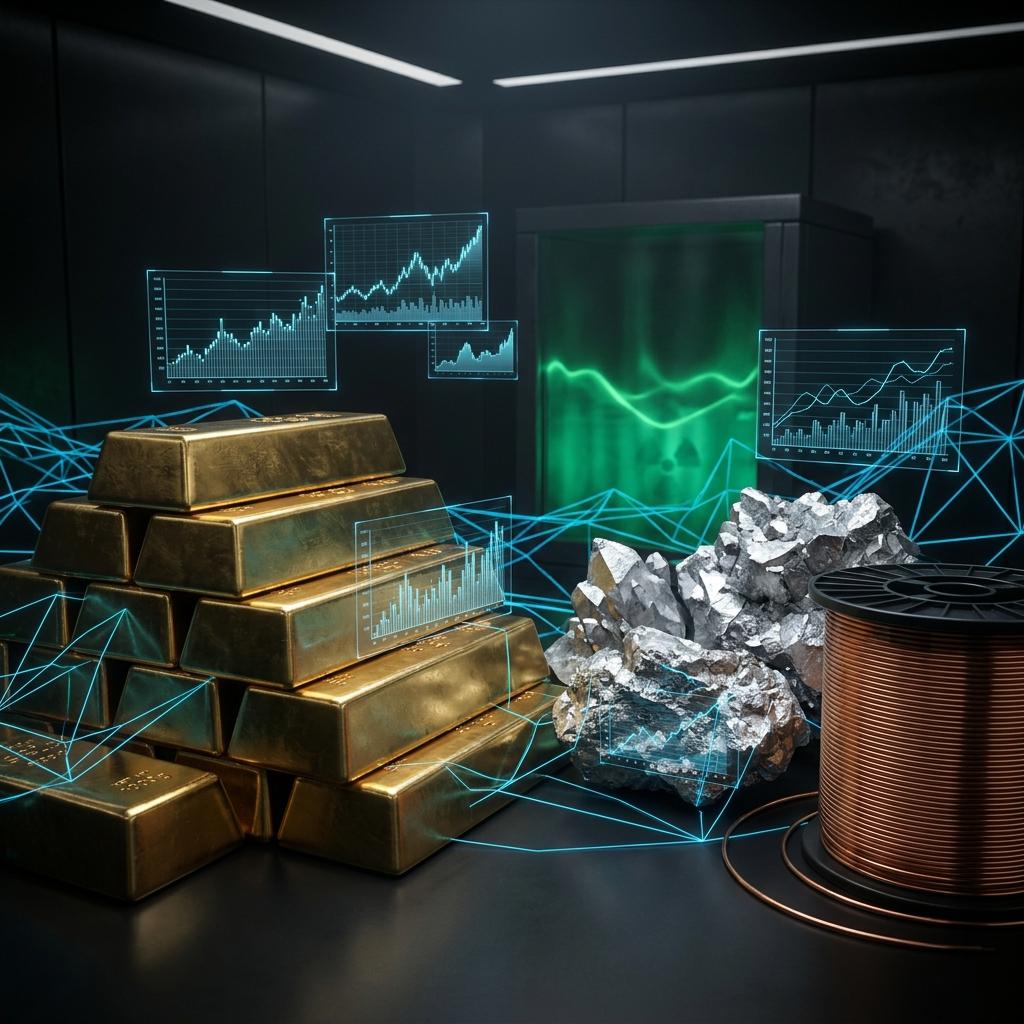
Here is a fact that should be a much bigger headline than it was: in 2025, the gold held by foreign central banks became worth more than their US Treasury holdings — for the first time since 1996.
Think about what that means. The world's central banks — the most conservative, slow-moving money managers on Earth — now place more value on a lump of inert metal than on the debt of the United States government. The last time that was true, the internet barely existed.
This is the other half of the story we told in The Future of Money. That article was about how money is becoming software — digital, programmable, instant. This one is about the strange and underappreciated flip side: as money goes digital, the world is quietly re-anchoring to hard, physical things you can dig out of the ground. Gold. Silver. Copper. Uranium.
It sounds like a contradiction. It isn't. It's the same story told from underground. Let's dig in.
Part 1: Gold's Quiet Comeback as Money
For decades, gold was treated as a relic — a nervous grandparent's asset, irrelevant in a world of digital finance. That view is now badly out of date.
Central Banks Are Hoarding It
The numbers are remarkable:
| Metric | Figure |
| Central bank gold buying, 2025 | ~863-1,200+ tonnes (16th straight year of net buying) |
| Projected 2026 buying | 750-850 tonnes — still historically exceptional |
| Largest 2025 buyer | Poland (+102 tonnes, to 550 total) |
| Biggest buyers 2020-2025 | China, Poland, Türkiye |
| BRICS+ share of global gold reserves | 17.4% (up from 11.2% in 2019) |
| Metric | Figure |
| Tokenized gold trading volume, Q1 2026 | ~$90.7 billion |
| Market leaders | Tether Gold (XAUT) + Paxos Gold (PAXG) = 96.7% of the market |
| Physical gold held by Tether alone | ~140 tonnes — more than most small/mid central banks |
| Total market cap forecast (end 2026) | ~$15 billion (roughly tripling from ~$5B) |
Sit with that Tether figure for a moment: a single stablecoin company now holds more physical gold than the official reserves of most of the world's central banks. The line between "crypto company" and "monetary institution" is dissolving in real time.
Tokenized gold is the perfect symbol of the whole transformation: the oldest money on Earth, riding the newest rails. It lets someone in any country hold a fraction of a gram of real gold, move it across the world in seconds, and use it as collateral in a DeFi protocol — all without a bank. Hard money meets programmable money.
Part 3: The Other Hard Assets — Metals That Build the Digital World
Gold is the monetary metal. But there is a second, equally important resource story, and it is the one almost nobody connects to the future of money: the digital economy runs on staggering quantities of industrial metal.
Every stablecoin transaction, every AI agent payment, every tokenized asset we described in the pillar piece ultimately runs on physical infrastructure — data centers, chips, power grids, cables. And that infrastructure is extraordinarily metal-hungry.
Copper: The Metal That Powers AI
Copper is the nervous system of electrification and computing, and AI is creating a demand shock:
- A single large AI data center can require up to 50,000 tonnes of copper
- Total data-center copper demand is projected at roughly 475,000 tonnes per year by 2026
- US data-center construction spending hit a $50.7 billion annual rate in early 2026 — up 28% year-on-year, now exceeding office construction
- S&P Global projects global copper demand rising from ~28 million tonnes (2025) to 42 million by 2040 — a 50% increase
- Permitting and development timelines average 15 to 17 years from discovery to production
- Ore grades are declining — miners dig more rock for less metal every year
- The discovery pipeline is weak: only about 5% of major copper deposits were found in the last decade
- Money is going digital, programmable, and fragmented across competing blocs (the pillar story)
- That fragmentation makes a neutral, un-freezable anchor more valuable than ever → central banks buy gold
- The digital infrastructure that runs the new money is physically metal-intensive → structural demand for copper, silver, uranium
- And gold itself is being pulled into the digital system through tokenization
- Hard assets have a renewed role. In a world of programmable, potentially freezable digital money, an asset that no government controls has obvious appeal. That is the central banks' logic, and it applies to individuals too — in moderation.
- Diversification, not all-in. Gold pays no yield and can fall hard; industrial metals are cyclical and volatile. The sane approach is a diversifier slice (commonly 5-15% for gold), not betting the house.
- Know your access route. Physical metal, ETFs, tokenized gold, and mining shares all behave differently. Tokenized gold is convenient and 24/7 but adds issuer counterparty risk — it is only as good as the company holding the vault.
- Watch the industrial-metal story, not just gold. The copper/silver/uranium supply crunch is a slower, less-hyped trend than gold, but it is arguably more structurally durable because it is bolted to the unstoppable AI buildout.
- Track the prices that matter. You can monitor live gold, silver, copper, and uranium prices — in any currency — with the free Convertz metals converter.
- Gold pays nothing. It has no yield, no dividend, no cash flow. In a world of 4-5% savings rates, holding gold has a real opportunity cost.
- It can crash. Gold has had brutal multi-year drawdowns before (it fell ~45% from 2011 to 2015). Record highs are not a guarantee of more highs.
- Tokenized gold adds counterparty risk. A token is only as trustworthy as the issuer and the audit of its vault. It reintroduces exactly the kind of "trust a company" risk that gold is supposed to avoid.
- Industrial metals are cyclical. A recession would crush copper and uranium demand regardless of the long-term AI story. The structural case is real; the timing is not guaranteed.
- "This time is different" is the most expensive phrase in finance. The hard-asset thesis is strong, but every bull market eventually overshoots. Position accordingly.
Silver: The Hidden Ingredient
Silver is both a precious metal and a critical industrial input — it is in nearly every electronic device and solar panel. The dual demand pushed silver to multi-year highs of $65-95 per ounce in late 2025-early 2026. It sits at the exact intersection of this article's two themes: a monetary metal and a building block of the digital economy.
Uranium: Feeding the Power-Hungry Machine
Here is the chain reaction almost nobody saw coming: AI needs data centers → data centers need enormous electricity → that electricity increasingly means nuclear power → which needs uranium. Uranium spot prices surged about 25% in January 2026, passing $100/lb for the first time in two years. The digital revolution is, indirectly, a nuclear-fuel story.
The takeaway: the more "virtual" money and commerce become, the more physical resources they consume underneath. There is no cloud — only someone else's data center, full of copper, drawing power from a uranium-fueled reactor.
Part 4: The Squeeze — Why Supply Can't Keep Up
The bullish case for hard assets is not really about demand. It is about the brutal mismatch between how fast demand is rising and how slowly supply can respond.
Consider copper:
Now overlay the timelines. AI and electrification demand is rising on a 2-to-5-year horizon. New mines take 15-plus years. That gap cannot be closed quickly at any price — you cannot conjure a copper mine into existence because ChatGPT got popular.
This is the structural engine under hard-asset prices: surging, inelastic demand meeting slow, constrained supply. It is also a real cost pressure on the digital transformation itself. The cost of building the future of money is, in part, the cost of the metal it is built from.
How This Connects Back to the Future of Money
Step back and the two stories lock together into one:
The future is not digital instead of physical. It is digital built on top of physical, and re-anchored to it for trust. The most futuristic and the most ancient assets are converging.
What It Means for You
The Risks and Counterpoints
An honest article names the other side:
The Bottom Line
The single most futuristic transformation in finance — money becoming software — is quietly re-anchoring the world to the most ancient assets we have. Central banks now value gold over US Treasuries for the first time in nearly 30 years. Tokenized gold is merging the 5,000-year-old store of value with blockchain rails. And the entire digital buildout sits on a foundation of copper, silver, and uranium that the world cannot mine fast enough.
The future of money is digital. But its foundation — its trust anchor and its physical infrastructure alike — is turning out to be very, very hard. The smart move is to understand both halves of the story, and to remember that in finance, the newest and the oldest ideas have a habit of meeting in the middle.
Track live gold, silver, copper, and uranium prices in any currency at Convertz.app.
This article is for informational and educational purposes only and does not constitute financial or investment advice. Precious and industrial metals are volatile and can lose value. Figures cited are drawn from reporting available in 2025-2026 and may change. Always consult a qualified financial advisor before making investment decisions.
Live Gold Price
Check the live spot price of gold per ounce, per gram, and per kilogram with our free metals calculator.
Tags

Andrew
·Founder of ConvertzBuilding free, accurate conversion tools for everyone. All content is AI-assisted and editorially reviewed for accuracy. Learn more about Convertz
Try Our Free Converters
Convert currencies, cryptocurrencies, units, and files instantly with our free online tools.
Related Articles

The End of Financial Privacy? Programmable Money and Who Controls Your Cash
Digital money can be tracked, controlled, and frozen in ways physical cash never could. As CBDCs, stablecoins, and programmable payments replace cash, who gets to watch — and who gets to decide what you can spend? The privacy battle behind the future of money.

When Software Becomes the Customer: Inside the AI-Agent Economy
For all of history, every transaction had a human on at least one end. In 2026 that ended — AI agents now shop, negotiate, and pay on their own. Here is how the machine economy works, who is racing to build its payment rails, and what it means for you.

The Future of Money: How the Global Financial System Is Being Rebuilt Right Now
A deep, evidence-based look at how money, payments, and the financial system itself are being rebuilt in 2026 — stablecoins, CBDCs, tokenized assets, AI-agent payments, and de-dollarization. What is actually happening, what it means for you, and where it leads by 2030.
Related across Convertz
Country guides, key terms, and rate history that connect to this article.
Country guides
Glossary
- Reserve CurrencyA reserve currency is held in significant quantities by central banks and other major fina…
- Money SupplyMoney supply is the total amount of money in circulation in an economy at a given time. Ce…
- Foreign Exchange ReservesForeign exchange (FX) reserves are foreign currencies and gold held by a central bank to s…