Trump's 10% Tariff: What It Costs Your Family
The Section 122 tariff costs families $1,300-$1,700/year per Yale Budget Lab. What's more expensive and how to protect your wallet.
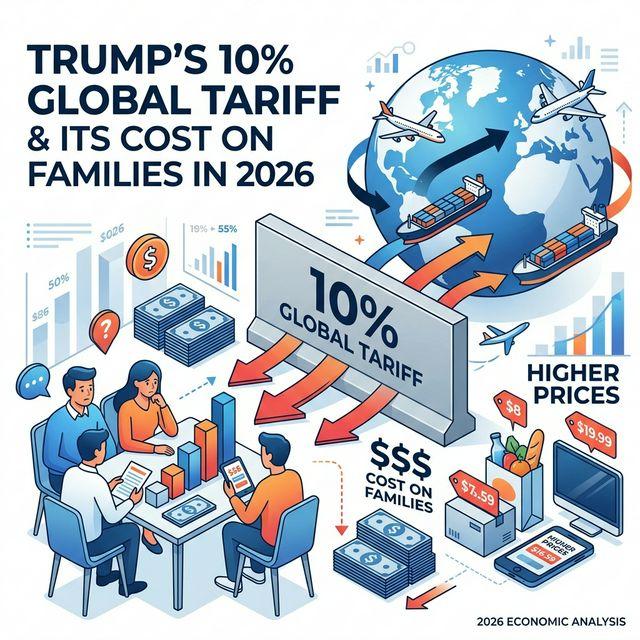
On February 24, 2026, a 10% tariff on imports from nearly every country in the world took effect under Section 122 of the Trade Act of 1974. The Yale Budget Lab estimates it costs the average American family $1,300 to $1,700 per year in higher prices. Cars are $3,300 more expensive. Groceries saw their biggest monthly spike since 2022. And the dollar has lost over 10% of its value against major currencies.
Here is exactly how much more you are paying, which products are hit hardest, and what you can do about it.
How We Got Here: From IEEPA to Section 122
The tariff story of 2025-2026 has been a rollercoaster:
- February 2025: Trump imposed 25% tariffs on Canada and Mexico and 10% on China using IEEPA (International Emergency Economic Powers Act), citing a fentanyl emergency. First time IEEPA was used for tariffs.
- April 2, 2025 ("Liberation Day"): Universal 10% tariff plus higher country-specific rates — China 60%, Vietnam 46%, Thailand 36%, India 26%.
- August 2025: Canada tariff increased from 25% to 35%.
- February 20, 2026: The Supreme Court ruled in Learning Resources Inc. v. Trump that IEEPA does not grant presidential authority to impose tariffs. All IEEPA tariffs struck down.
- February 24, 2026: Within hours, the administration pivoted to Section 122 of the Trade Act of 1974, imposing a 10% tariff on nearly all imports. This has a 150-day duration expiring July 24, 2026, unless Congress extends it.
- Confidence erosion: Tariffs undermined the dollar's safe-haven status and investor confidence in U.S. Treasuries
- Retaliatory tariffs: As of September 2025, threatened and imposed retaliation affected $223 billion of U.S. exports (Trade.gov)
- Growth concerns: J.P. Morgan and Barclays both forecasted a U.S. recession in 2025
- Goldman Sachs: tariffs increased inflation by approximately 0.5 percentage points in 2025
- CBO: tariffs increase average annual inflation by approximately 0.4 percentage points over 2025-2026
- Morningstar: inflation ticking up to 2.7% in 2026 Here is the critical shift: in 2025, businesses absorbed roughly 80% of tariff costs to maintain market share. J.P. Morgan projects businesses may only absorb 20% in 2026, passing far more directly to consumers (Morningstar).This means the real consumer impact of tariffs is just beginning to show up in prices.
- China: Tit-for-tat escalation reached 125% tariffs on each other before both sides reduced to 10% for 90 days in May 2025, extended through November 2026
- Canada: Retaliatory tariffs took effect March 5, 2025
- EU: Three rounds of retaliatory tariffs through December 2025 (before a US-EU deal in August 2025) Retaliatory tariffs hit U.S. exporters — farmers, manufacturers, and service providers who sell abroad. Farm bankruptcies surged as China dramatically cut U.S. soybean purchases and Mexico retaliated on corn, soybeans, and dairy.
- If Congress extends it: expect continued price pressure and weaker dollar
- If it expires: some relief on consumer prices, but Section 232 tariffs (steel, aluminum, autos) remain in place regardless
- CLARITY Act connection: the broader legislative agenda includes trade policy reform alongside crypto regulation
- Buy domestic when price-competitive — especially for produce, meat, and household goods
- Lock in exchange rates before traveling — the dollar may weaken further. Use Convertz to compare rates
- Delay major purchases if possible — auto and housing tariffs may ease if Section 122 expires in July
- Compare international money transfer services — hidden fees compound the weaker dollar. Our currency converter shows real mid-market rates
- Track grocery inflation — store brands and seasonal produce offer the best value during inflationary periods
The result: the effective U.S. tariff rate reached 7.7% in 2025 — the highest since 1947 — and stands at 5.6% in 2026, the highest since 1972 (Tax Foundation).
For context, Trump's tariff increases are comparable to or larger than the infamous Smoot-Hawley Act of 1930, which raised tariffs from 13.5% to 20% and is widely blamed for deepening the Great Depression.
What It Costs Your Family
The Dollar Amount
| Source | Estimated Annual Cost Per Household | |
| Yale Budget Lab | $1,300-$1,700 | |
| Tax Foundation (2025 tariffs) | ~$1,000 | |
| Tax Foundation (2026 additional) | $600-$1,000 | |
| Combined estimate | ~$1,500-$2,700 | |
| Income Group | Tariff Cost as % of Income | |
| Bottom 20% (under $29,000) | 6.2% | |
| Middle 20% | ~3.5% | |
| Top 1% (over $915,000) | 1.7% | |
| Currency Pair | Current Rate | Direction |
| EUR/USD | ~1.22 | Dollar weaker (was ~1.05 in early 2025) |
| GBP/USD | ~1.35 | Dollar weaker (4-year high for pound) |
| USD/JPY | Falling | Dollar weaker against yen |
| USD/CAD | Mixed | USMCA exemptions add complexity |
| Source | 2026 GDP Forecast | Notes |
| OECD | 1.5% | Down from 2.8% in 2024 |
| Deloitte | 1.9% | Assumes tariffs ease to ~7.5% |
| J.P. Morgan | Near recession | Forecasted contraction in 2025 |
U.S. GDP growth has nearly halved from 2024 to 2026. The OECD attributes the slowdown primarily to trade policy uncertainty and tariff impacts.
What Happens Next
The Section 122 tariff expires July 24, 2026 unless Congress acts:
The China tariff truce (10% on each side) is extended through November 2026. If negotiations break down, the return to 125% tariffs would be devastating for consumer prices.
How to Protect Your Wallet
While you cannot avoid tariffs entirely, you can minimize their impact:
Compare real-time exchange rates across 150+ currencies with Convertz. See exactly how much your dollar buys today vs. last year.
Disclaimer
This article is for informational purposes only and does not constitute financial or investment advice. Economic data and projections are based on publicly available research and may change. Always verify current prices and exchange rates before making financial decisions.
Live Currency Converter
Convert between 150+ currencies at the live mid-market rate — refreshed every minute from Frankfurter (ECB reference data).

Andrew
·Founder of ConvertzBuilding free, accurate conversion tools for everyone. All content is AI-assisted and editorially reviewed for accuracy. Learn more about Convertz
Try Our Free Converters
Convert currencies, cryptocurrencies, units, and files instantly with our free online tools.
Related Articles

The End of Financial Privacy? Programmable Money and Who Controls Your Cash
Digital money can be tracked, controlled, and frozen in ways physical cash never could. As CBDCs, stablecoins, and programmable payments replace cash, who gets to watch — and who gets to decide what you can spend? The privacy battle behind the future of money.

When Software Becomes the Customer: Inside the AI-Agent Economy
For all of history, every transaction had a human on at least one end. In 2026 that ended — AI agents now shop, negotiate, and pay on their own. Here is how the machine economy works, who is racing to build its payment rails, and what it means for you.

Gold Just Beat US Treasuries — The Hard-Asset Side of the New Money System
For the first time since 1996, the gold held by foreign central banks is worth more than their US Treasury holdings. As money goes digital, the world is quietly re-anchoring to hard assets — gold, silver, copper, uranium. Here is the resource story behind the financial revolution.
Related across Convertz
Country guides, key terms, and rate history that connect to this article.