Iran War: How $120 Oil Hits Everything You Buy
Brent crude near $116/barrel is driving up gas, food, shipping, and electricity costs. How the Iran oil disruption hits your wallet.
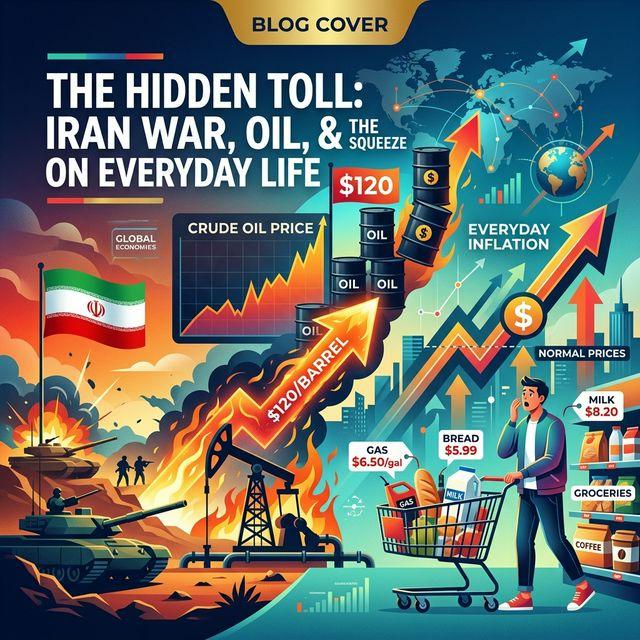
Brent crude hit $116 per barrel on March 19, 2026 — its highest level since Russia's invasion of Ukraine in 2022. The Iran conflict has disrupted roughly 3.2 million barrels per day of production capacity and introduced risk to the Strait of Hormuz, through which 20% of the world's oil supply transits daily. But crude oil prices do not just affect what you pay at the gas pump. They ripple through every single thing you buy.
Here is exactly how $116 oil hits your wallet, which currencies are winning and losing, and what you can do about it.
Why Oil Is at $116 Per Barrel
The current oil price spike traces directly to the escalating Iran conflict and expanded sanctions enforcement. Iran was producing approximately 3.2 million barrels per day before disruptions — making it the sixth-largest oil producer globally.
Three factors are keeping prices elevated:
- Direct supply loss — Iranian crude exports have dropped significantly as sanctions enforcement tightened and military operations disrupted production infrastructure
- Strait of Hormuz risk premium — roughly 21 million barrels per day flow through this narrow chokepoint between Iran and Oman. Any threat to this route adds a fear premium to global oil
- OPEC+ production discipline — Saudi Arabia and other OPEC+ members have been reluctant to significantly increase output, keeping the market tight even as demand rises
- Fresh produce — highest transport sensitivity, up 8-12%
- Meat and dairy — energy-intensive production, up 6-10%
- Packaged goods — plastic packaging (petroleum-based), up 4-7%
- Bread and baked goods — wheat + transport + energy, up 5-9%
- 0-30 days: Fuel surcharges appear on shipping invoices
- 30-60 days: Wholesalers and distributors raise prices to retailers
- 60-90 days: Retail shelf prices increase Products with the longest supply chains (anything manufactured in Asia and shipped to the US or Europe) face the steepest increases — typically 3-8% above pre-crisis pricing.
- Fuel surcharges: Most carriers have added $30-$80 per round-trip ticket
- Reduced capacity: Several airlines have cut routes on less profitable segments
- Hedging losses: Airlines that hedged fuel at lower prices are protected temporarily, but new contracts are locking in higher rates For travelers, this means:
- Domestic flights are up roughly $40-$70 per round trip
- International long-haul flights are up $100-$200
- Budget carriers with thinner margins are raising prices fastest If you are planning international travel, compare exchange rates before booking — the currency impact can be as significant as the fare increase. Use Convertz to check real-time rates for your destination.
- Consolidate trips — combine errands to reduce fuel consumption. The savings compound more than you think at $4.35/gallon.
- Buy groceries seasonally and locally — locally grown produce avoids the longest transportation chains and the steepest price markups.
- Lock in energy rates — if your utility offers fixed-rate plans, consider switching before rates rise further.
- Delay major imports — if you are waiting on furniture, appliances, or electronics shipped from overseas, prices may stabilize in 3-6 months as shipping surcharges normalize.
- Check exchange rates before international purchases — the dollar's relative strength means some foreign goods may actually be cheaper right now despite oil-driven inflation. Compare rates at Convertz.
- Consider fuel-efficient options — EV and hybrid vehicles are seeing increased demand. Even small changes like maintaining tire pressure and reducing highway speed save meaningful fuel at current prices.
The Federal Reserve specifically cited Brent crude near $116 as a key factor in raising its 2026 inflation outlook to 2.7% at the March 19 FOMC meeting.
The Gas Pump: First and Most Visible Impact
The most direct hit is at the fuel pump. The general rule: every $10 increase in crude oil adds $0.25-$0.30 per gallon to US retail gasoline.
| Fuel Type | National Average (March 2026) | Year Ago | |
| Regular Gasoline | ~$4.35/gallon | $3.45 | |
| Premium Gasoline | ~$5.10/gallon | $4.15 | |
| Diesel | ~$4.75/gallon | $3.70 | |
| Currency | YTD Change vs USD | Why | |
| Canadian Dollar (CAD) | +4.2% | Oil sands production, #4 global exporter | |
| Norwegian Krone (NOK) | +6.1% | North Sea production, sovereign wealth fund | |
| Saudi Riyal (SAR) | Pegged | Massive revenue windfall | |
| UAE Dirham (AED) | Pegged | Revenue surge funding diversification | |
| Currency | YTD Change vs USD | Why | |
| Japanese Yen (JPY) | -5.8% | Imports 90%+ of oil, trade deficit widening | |
| Indian Rupee (INR) | -4.1% | Third-largest oil importer, subsidy burden | |
| Turkish Lira (TRY) | -8.3% | Energy import dependent, existing inflation crisis | |
| Euro (EUR) | -2.4% | EU energy dependency, industrial slowdown | |
| Crisis | Peak Price (inflation-adjusted) | Duration | Economic Impact |
| 1973 Arab Oil Embargo | ~$65/barrel | 6 months | US recession, gas rationing |
| 1979 Iran Revolution | ~$125/barrel | 18 months | Stagflation, double-digit inflation |
| 1990 Gulf War | ~$75/barrel | 9 months | Mild recession |
| 2008 Speculation Peak | $147/barrel | 5 months | Contributed to financial crisis |
| 2022 Russia-Ukraine | $130/barrel | 8 months | Global inflation surge |
| 2026 Iran Conflict | $116/barrel | Ongoing | TBD |
The 2022 spike is the most relevant comparison. That crisis saw oil hit $130 before gradually declining as strategic petroleum reserves were released, demand adjusted, and alternative supply sources came online. The entire cycle from spike to normalization took roughly eight months.
Goldman Sachs projects Brent averaging $105-$115 through Q3 2026, with a gradual decline toward $90-$95 by year-end contingent on diplomatic progress.
What You Can Do About It
While you cannot control oil prices, you can minimize their impact:
Data sourced from the Energy Information Administration, Federal Reserve FOMC statements, Bureau of Labor Statistics, cited financial institutions, and industry estimates. All prices and rates are as of March 2026 and subject to change.
Disclaimer
This article is for informational purposes only and does not constitute financial or investment advice. Energy markets are volatile and projections may change. Always verify current prices and exchange rates before making financial decisions.
Live Currency Converter
Convert between 150+ currencies at the live mid-market rate — refreshed every minute from Frankfurter (ECB reference data).

Andrew
·Founder of ConvertzBuilding free, accurate conversion tools for everyone. All content is AI-assisted and editorially reviewed for accuracy. Learn more about Convertz
Try Our Free Converters
Convert currencies, cryptocurrencies, units, and files instantly with our free online tools.
Related Articles

The End of Financial Privacy? Programmable Money and Who Controls Your Cash
Digital money can be tracked, controlled, and frozen in ways physical cash never could. As CBDCs, stablecoins, and programmable payments replace cash, who gets to watch — and who gets to decide what you can spend? The privacy battle behind the future of money.

When Software Becomes the Customer: Inside the AI-Agent Economy
For all of history, every transaction had a human on at least one end. In 2026 that ended — AI agents now shop, negotiate, and pay on their own. Here is how the machine economy works, who is racing to build its payment rails, and what it means for you.

Gold Just Beat US Treasuries — The Hard-Asset Side of the New Money System
For the first time since 1996, the gold held by foreign central banks is worth more than their US Treasury holdings. As money goes digital, the world is quietly re-anchoring to hard assets — gold, silver, copper, uranium. Here is the resource story behind the financial revolution.
Related across Convertz
Country guides, key terms, and rate history that connect to this article.
Country guides
Glossary
- PetrodollarThe petrodollar is the term for US dollars earned by oil-exporting countries through inter…
- Foreign Exchange ReservesForeign exchange (FX) reserves are foreign currencies and gold held by a central bank to s…
- Wire TransferA wire transfer is a bank-to-bank electronic transfer of funds, typically settling same-da…