Dollar Dying: USD Hits Lowest Reserve Share Since 1995
The dollar's reserve share fell to 56.32% — lowest since 1995. China slashed Treasuries by 47%, BRICS settle 99% in local currencies, gold soaring.
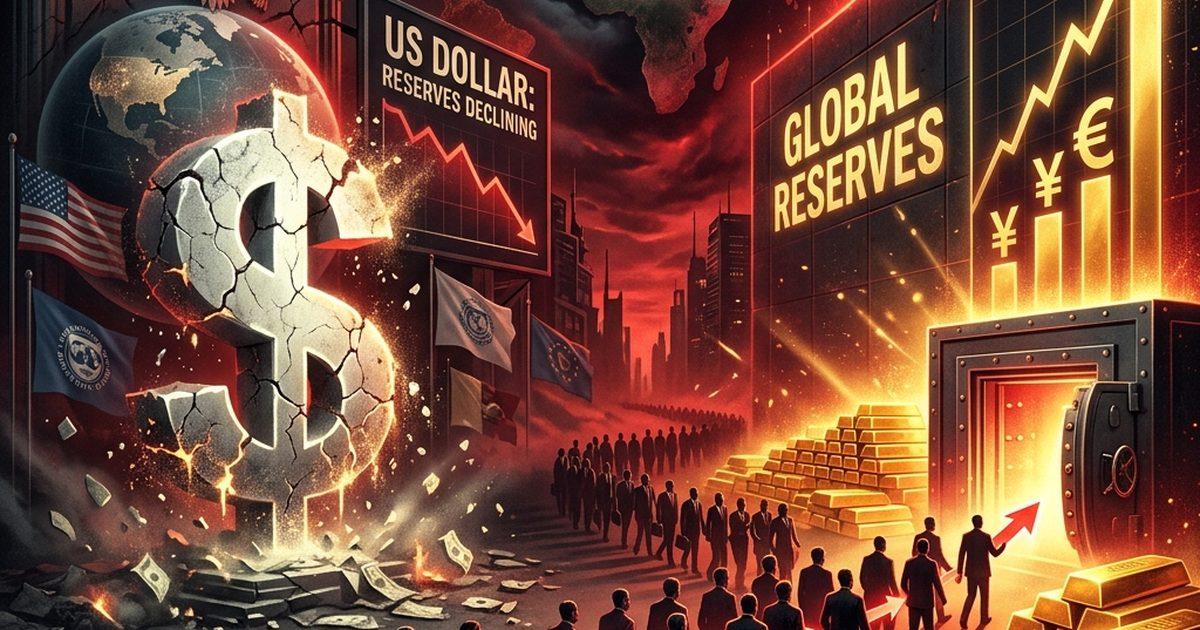
The US dollar's share of global foreign exchange reserves has dropped to 56.32% — a 31-year low not seen since 1995. Down from 71% in 2001, the decline represents the most significant erosion of dollar dominance in modern history.
China has slashed its Treasury holdings by 47%. Russia and China settle 99.1% of bilateral trade without touching a single dollar. Central banks bought 863 tonnes of gold last year. And the Dollar Index has fallen 10.91% in twelve months.
The dollar is not collapsing overnight. But the data tells a story that is impossible to ignore.
The Reserve Currency Decline in Numbers
The IMF's COFER (Currency Composition of Official Foreign Exchange Reserves) dataset tracks what central banks around the world hold. The trend is unmistakable:
| Year | USD Reserve Share | What Was Happening |
| 2001 | 71-72% (peak) | Post-dot-com, pre-Euro adoption |
| 2010 | ~62% | Post-financial crisis diversification |
| 2020 | 59% | COVID era, 25-year low at that time |
| 2024 | ~58-59% | De-dollarization accelerates |
| Q2 2025 | 56.32% | 31-year low |
| Country | Tonnes Purchased | Total Reserves |
| Poland | 102 tonnes | ~550 tonnes |
| Kazakhstan | 57 tonnes (record) | ~400+ tonnes |
| Brazil | 43 tonnes | Re-entered market after 2021 pause |
| China | 27 tonnes (official) | ~2,298 tonnes |
| Bank | DXY Forecast | EUR/USD Forecast |
| Morgan Stanley | 94 (mid-year) → 100 (year-end) | 1.23 → 1.16 |
| JPMorgan | Mid-to-low 90s | ~1.20 |
| Bank of America | Low 90s | ~1.22 |
| Currency | Current Reserve Share | Role |
| US Dollar | 56.32% | Still dominant but declining |
| Euro | 21.13% | Gaining slowly |
| Japanese Yen | ~6% | Stable |
| British Pound | ~5% | Stable |
| Chinese Yuan | ~2% | Growing with trade deals |
| Gold | ~23% of reserves | Surging as neutral asset |
| Other currencies | 20.43% (combined) | Diversifying rapidly |
The "other" category — which includes the Australian dollar, Canadian dollar, Swiss franc, and emerging market currencies — has grown from negligible to over 20% of global reserves. This fragmentation benefits no single currency. It benefits assets that are nobody's liability — like gold and potentially Bitcoin.
How to Track This Shift in Real Time
The de-dollarization trend directly impacts exchange rates, gold prices, and crypto valuations. Whether you are converting USD to EUR for a European vacation, tracking gold in different currencies, or monitoring how the yuan moves against the dollar — Convertz.app gives you real-time data across 160+ currencies, precious metals, and cryptocurrencies in one place.
The Bottom Line
The dollar is not dying in the dramatic, headline-grabbing sense. But it is losing market share at the fastest rate in modern history. Central banks are diversifying. BRICS nations are building alternatives. Gold is replacing Treasuries in reserve portfolios.
The 56.32% reserve share is not a crisis point — but it is a trend line that has moved in only one direction for 25 years. And for the first time, the infrastructure to operate without the dollar is being actively built, funded, and deployed.
The question is no longer whether de-dollarization is happening. The question is how fast — and what replaces the share that the dollar loses.
This article is for informational purposes only and does not constitute financial or investment advice. Currency markets are volatile and influenced by many factors. Always do your own research before making financial decisions.
Live Gold Price
Check the live spot price of gold per ounce, per gram, and per kilogram with our free metals calculator.

Andrew
·Founder of ConvertzBuilding free, accurate conversion tools for everyone. All content is AI-assisted and editorially reviewed for accuracy. Learn more about Convertz
Try Our Free Converters
Convert currencies, cryptocurrencies, units, and files instantly with our free online tools.
Related Articles

The End of Financial Privacy? Programmable Money and Who Controls Your Cash
Digital money can be tracked, controlled, and frozen in ways physical cash never could. As CBDCs, stablecoins, and programmable payments replace cash, who gets to watch — and who gets to decide what you can spend? The privacy battle behind the future of money.

When Software Becomes the Customer: Inside the AI-Agent Economy
For all of history, every transaction had a human on at least one end. In 2026 that ended — AI agents now shop, negotiate, and pay on their own. Here is how the machine economy works, who is racing to build its payment rails, and what it means for you.

Gold Just Beat US Treasuries — The Hard-Asset Side of the New Money System
For the first time since 1996, the gold held by foreign central banks is worth more than their US Treasury holdings. As money goes digital, the world is quietly re-anchoring to hard assets — gold, silver, copper, uranium. Here is the resource story behind the financial revolution.
Related across Convertz
Country guides, key terms, and rate history that connect to this article.
Country guides
Glossary
- PetrodollarThe petrodollar is the term for US dollars earned by oil-exporting countries through inter…
- Safe-Haven CurrencyA safe-haven currency is one that investors buy during periods of global financial stress,…
- Foreign Exchange ReservesForeign exchange (FX) reserves are foreign currencies and gold held by a central bank to s…