2026 Cost of Living: How Much More vs 2020?
Inflation since 2020 hit 25.7%. Auto insurance up 55%, eggs 69%, rent 36%. See how much more every category costs vs your income.
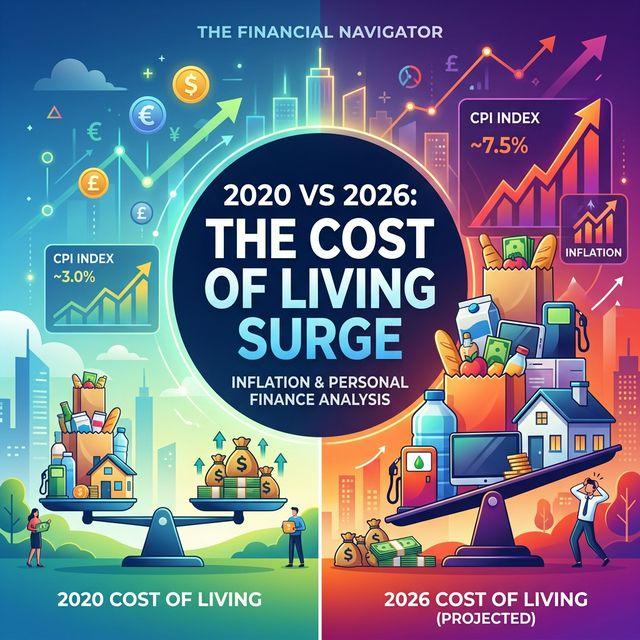
Since January 2020, cumulative inflation in the United States has reached 25.7%, according to Bureau of Labor Statistics CPI data. That means $100 worth of goods in 2020 now costs about $125.67. Your auto insurance is up 55%. A dozen eggs costs 69% more. Rent in major cities has jumped 36%. And despite nominal pay raises, real wages have barely moved.
Here is a category-by-category breakdown of exactly how much more everything costs, how your income compares, and what (if anything) actually got cheaper.
The Big Picture: 25.7% Cumulative Inflation
The average annual inflation rate from 2020 to 2026 has been 3.88% — more than double the roughly 10% cumulative inflation seen in the five years before the pandemic (BLS). Inflation peaked at 9.1% in June 2022, the highest in over 40 years, driven by pandemic supply chain disruptions, stimulus spending, and the energy crisis.
As of February 2026, year-over-year inflation has cooled to 2.4% — approaching the Fed's 2% target. But the damage is cumulative. Prices don't go back down when inflation slows; they just stop rising as fast.
Category-by-Category: What Costs More in 2026
Groceries: +29.4%
Food-at-home prices have risen 29.4% from March 2020 to December 2025 (BLS). The USDA projects an additional 2.5% increase in 2026. Here's what specific staples look like:
| Item | 2020 Price | 2026 Price | Change |
| Eggs (dozen, Grade A) | $1.48 | $2.50 | +69% |
| Bread (white, per lb) | $1.20 | $1.83 | +53% |
| Milk (whole, per gallon) | $3.27 | $4.07 | +24% |
| Metric | 2020 | 2025-2026 | Change |
| Median Household Income | $67,521 | $83,592 | +23.8% |
| Cumulative Inflation | — | — | +25.7% |
| Real Wage Growth (net) | — | — | ~0% (flat) |
| Country | Cumulative Inflation (2020-2025) | Current Rate (Early 2026) | |
| United States | ~23-26% | 2.4% | |
| United Kingdom | ~20-25% | 3.0% | |
| Australia | ~22% | ~2.6% | |
| Canada | ~19-20% | ~2.1% | |
| Eurozone | ~18-22% | 1.9% |
The UK experienced the highest peak inflation at 11.1% in October 2022 — a 41-year record. The Eurozone currently has the lowest rate. Use our currency converter to see how exchange rate movements compound these differences when sending money internationally.
The Interest Rate Factor
The Federal Reserve's response tells the story:
Higher interest rates mean more expensive mortgages (the average 30-year rate was around 2.7% in 2020 versus 6.5-7% in 2026), auto loans, and credit card debt. A $300,000 mortgage costs roughly $600 more per month at 7% than it did at 2.7%.
What You Can Do About It
All data sourced from the Bureau of Labor Statistics, Federal Reserve Economic Data (FRED), USDA Economic Research Service, Census Bureau, Energy Information Administration, and cited research institutions. Figures are as of March 2026 and subject to revision.
Disclaimer
This article is for informational purposes only and does not constitute financial or investment advice. Economic data and projections are based on publicly available research and may change. Always verify current prices and rates before making financial decisions.
Live Currency Converter
Convert between 150+ currencies at the live mid-market rate — refreshed every minute from Frankfurter (ECB reference data).

Andrew
·Founder of ConvertzBuilding free, accurate conversion tools for everyone. All content is AI-assisted and editorially reviewed for accuracy. Learn more about Convertz
Try Our Free Converters
Convert currencies, cryptocurrencies, units, and files instantly with our free online tools.
Related Articles

The End of Financial Privacy? Programmable Money and Who Controls Your Cash
Digital money can be tracked, controlled, and frozen in ways physical cash never could. As CBDCs, stablecoins, and programmable payments replace cash, who gets to watch — and who gets to decide what you can spend? The privacy battle behind the future of money.

When Software Becomes the Customer: Inside the AI-Agent Economy
For all of history, every transaction had a human on at least one end. In 2026 that ended — AI agents now shop, negotiate, and pay on their own. Here is how the machine economy works, who is racing to build its payment rails, and what it means for you.

Gold Just Beat US Treasuries — The Hard-Asset Side of the New Money System
For the first time since 1996, the gold held by foreign central banks is worth more than their US Treasury holdings. As money goes digital, the world is quietly re-anchoring to hard assets — gold, silver, copper, uranium. Here is the resource story behind the financial revolution.
Related across Convertz
Country guides, key terms, and rate history that connect to this article.
Country guides
Glossary
- Foreign Exchange ReservesForeign exchange (FX) reserves are foreign currencies and gold held by a central bank to s…
- Wire TransferA wire transfer is a bank-to-bank electronic transfer of funds, typically settling same-da…
- PetrodollarThe petrodollar is the term for US dollars earned by oil-exporting countries through inter…